Mappeditalia.it © Tutti i diritti riservati


HISTORICAL INFORMATION
TOURIST ROUTE - FIRST PART
TOURIST ROUTE - SECOND PART
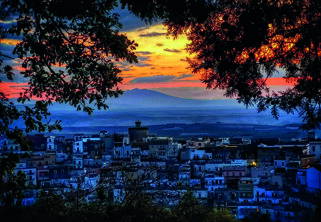
Minervino Murge, a municipality in Alta Murgia, stands on two hills about 500 meters above sea level. Its strategic position allows visitors to see a boundless territory whose Mediterranean scrub extends to the Locone basin, the Ofanto Valley and the Tavoliere: it is precisely for this reason that the town has earned the nickname of Balcony of the Murge. There are two hypotheses on the origin of the name; the first, of mythological origin, is linked to the goddess Minerva who has always been considered the protector of the olive tree and who, among other things, was the first to find a way to weave wool. This version can be quite credible if you think about the wealth of olive trees and flocks in this area. The second considers the etymology attributable to mons – herbidus, that is to say grassy mountain, land for pastures. According to a legend, Minervino was founded in 216 BC. when some Roman legionaries, escaping the battle of Cannae, found refuge on the Murge. Here they fell in love with the local shepherdesses and decided to stay, celebrating the wedding rites in a cave that they themselves dedicated to the goddess Minerva. Archaeological research has established that the origins date back to prehistory. Traces of settlements dating back to the fifth millennium have been found a short distance from the current town. The first inhabited nucleus had its maximum extension in the fourth century BC where the castle and the Cathedral stand. The first settlements were founded between the eighth and seventh centuries BC on the slopes that slope down towards the Grotta di San Michele; starting from here the town spread out like a fan towards the south-west, having as its northern limit the impluvium that descends from the Murge called Matitani (from the Greek metateo: to flow). From the third century AD to the ninth the history of Minervino becomes obscure. In the sources we find it mentioned during the clashes between the Lombards and the Saracens, it was taken and sacked by the Saracens in 862 and then again in 875. Between the end of the 10th century and the beginning of the 11th the city became the seat of a bishop and remained so until 1818, when it was incorporated into the diocese of Andria. With the expulsion of the Byzantines from southern Italy, in 1042 it suffered the Norman invasion and was assigned to Raimfrido D'Altavilla. After the Normans, the fiefdom was entrusted to Giovanni Pipino, known for his cruelty, but also for his dedication and his care of the castle. He was succeeded by the Orsini, the Del Balzo, the Pignatelli, the Carafa and the Del Tufo. In the 20th century. Minervino Murge, like other surrounding towns, was a land of clashes between groups of fascists, namely the large landowners, and socialists, namely the farmers who organized themselves to claim their rights. These clashes then led to the construction of the votive lighthouse, a monument to the fallen fascists.
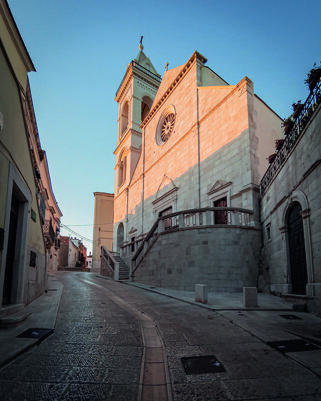
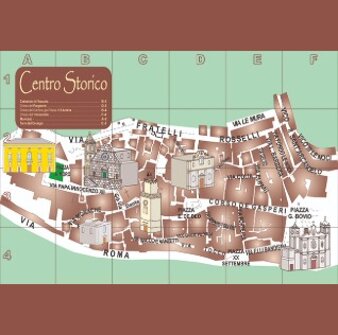
We begin our itinerary from the Baronial Palace or Castle, located in the north, it dominates the territory, in a clear defensive position, today the seat of the Town Hall. The oldest wing was built by the Normans and completed at the beginning of the 14th century as attested by the coat of arms of the feudal lord Giovanni Pipino placed at the entrance of a tower that houses the Archaeological Museum. In the first half of the 17th century the Pignatelli Princes, feudal lords between 1619 and 1657, transformed it from a fortress into a noble residence by adding the front body and the facade, which a large courtyard separates from the Norman part. From the courtyard you can access the permanent Archaeological Exhibition "When the Ofanto was the color of amber" with finds from the 7th to the 2nd century BC. Of notable charm is the reconstruction of the tomb of the "victorious warrior". The Town Hall also houses the “Roccotelli” Art Gallery, a real path that, starting from the majestic staircase, takes you to the heart of the castle where you can admire the paintings and sculptures of Michele Roccotelli from Minervino among the entrance halls, rooms, towers and corridors. Behind the castle is the Ethnographic Museum of “Peasant Civilization and Transhumance”. Leaving the castle, going down Via Dante you can admire Palazzo Caputi and the Church of San Francesco d’Assisi, built together with the Convent of the Friars Minor Observant by order of Ramondello Orsini, Prince of Taranto and his wife Maria d’Enghien. The baroque canopy in gilded wood of the high altar (7th century) and the choir above the entrance are beautiful. Continuing along Via Dante to reach the Cathedral dedicated to the Virgin of the Assumption, you pass by the ancient Monastery of the Poor Clares, now home to the Lyceum. The Cathedral was the seat of the Bishops of Minervino from the 11th century until 1818. Rebuilt on the site of the previous Norman construction, it was consecrated in 1608. It is also called the mother church as it was the main church until the establishment of the new parishes in 1800. The façade, built in white limestone, has a Romanesque rose window and three Renaissance portals. The interior is divided into three naves separated by Renaissance columns and is covered by a truss vault. On the main altar (18th century) there is a small marble temple in which the Holy Crucifix is kept, called the Black Crucifix which in ancient times, considered miraculous by the faithful, was carried in procession during periods of drought to propitiate rain. From the arch on the left you enter through a neo-Gothic style door, into the 19th century Sacello. Noteworthy is the Renaissance baptismal font, unique in the entire town until 1884.
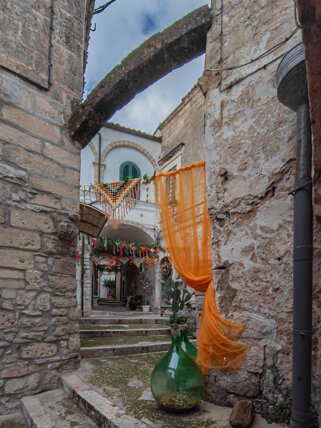
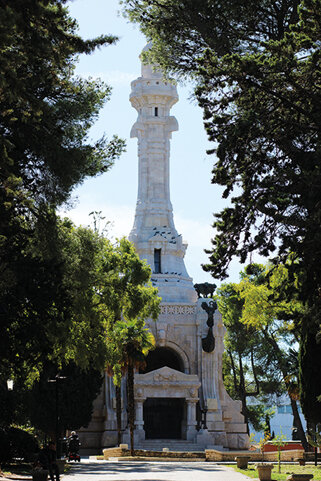
Going down the stairs behind the Cathedral we enter the oldest part of Minervino called “Scesciola”, characterized by a labyrinth of irregularly shaped streets, ramps, whitewashed houses, clinging to the slopes of the hill and close to each other in a continuous succession of tuff arches. There are numerous sacred shrines, evidence of the deep faith of the inhabitants. Walking along Via Papa Innocenzo XII, among the numerous noble buildings of the 18th and 19th centuries, you can see the Clock Tower, built in the 15th century by the Pirro-Del Balzo family: the tower was built for civic purposes, for signaling and providing emergency services to the surrounding area. Later in the 18th century it became a bell tower. Going along the side street in front of the Tower you reach the birthplace of the Jacobin pror-martyr Emanuele and Deo. Once you reach Piazza De Deo, the ancient square called “del Sedile”, you can see the Church of the Conservatory, while from the same square, along Via Santa Caterina, you can reach the small church of the Madonna di Costantinopoli, considered one of the oldest. The church was built by Prince Pignatelli on the site of the discovery of an image of the Virgin considered miraculous. On the only altar, in fact, you can see a fresco of the Virgin with Child. Along Corso Matteotti, you can see the imposing fifteenth-century Tower, one of the most significant monuments in Minervino. In 1454, upon the death of Gabriele Orsini, Duke of Venosa, who was also Barion of Minervino, the city was inherited by his daughter Maria Donata, who was married to Pirro Del Balzo, who between 1454 and 1462 built the Tower initially as an observatory. It is a massive construction with a circular plan and thick walls on several floors, connected for defense reasons by wooden escalators. The building was located outside the town and remained so until the end of the 17th century when the town began to expand towards the south. At the end of the street, preceded by a wide staircase, stands the Church of San Michele in living stone (1856) with an octagonal plan and full of interesting paintings. Going up Via Di Vagno we arrive at the Villa Comunale where the Votive Lighthouse stands. A monument erected to exalt fascism and its fallen. Its construction, begun in 1923 and completed after nine years, is due to the commemoration of the fallen Riccardo Barbera in Molfetta. Mussolini himself offered £10,000 for its construction. When fascism fell, the communists wanted to demolish that mausoleum, but the surveyor Tommaso Barbera, a member of the P.S.I., actively worked to prevent this from happening and it was converted into a monument to the Fallen of Puglia.
TOURIST ROUTE - THIRD PART
TOURIST ROUTE - FOURTH PART
NATURE TRAILS
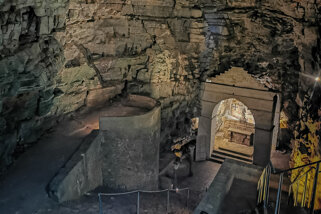
On a dice-shaped base stands a large column that appears to be a large fasces, above which is placed the rotating lantern that radiates a beam of light of modest intensity that replaces the original one donated by the Ministry of the Merchant Navy with a power of 2 million candles, which at the time was visible for a radius of 80 km. The structure, 32 meters high, is entirely built in hard stone from Minervino, and, inside the column, a spiral staircase climbs, with which you can access the loggia from where you can admire all of Minervino and the landscape below, even managing to glimpse the Gulf of Manfredonia, the Gargano and a good part of the Tavoliere delle Puglie. The monument was restored on the occasion of the centenary of the laying of the first stone (years 2023-2024). In Via Imbriani you can visit the Church of the Blessed Virgin Crowned, built in 1855 on an ancient suburban chapel dedicated to Saint Mark the Evangelist, to which the faithful contributed with offerings. Outside the town, located at the foot of Minervino Murge, in a valley at the end of that natural canal, once a stream, called "Matitani", is the cave of San Michele. It is a karst cavity whose formation dates back to the Quaternary (2 million years ago), a period in which this area, until then submerged, began to rise above sea level. The first written evidence, referring to this cave, can be found in a parchment preserved in the Abbey of Montecassino, dated 12 February of the year 1000. The cave must, however, have been known and frequented in the past and presumably in the early Christian era. An ancient place of Michaelic worship, the cave has historical, artistic and speleological interest.
A short distance from the cave is the Church of the Madonna della Croce with frescoes and a painting of the Virgin with Child. In the chapel of San Pietro there is an interesting mortar floor. On the road to Lavello, 2 km from the town centre, stands the Sanctuary of the Madonna del Sabato, Protector of Minervino. It was built towards the middle of the 17th century on a Basilian cave dug into the tuff, where an image of the Virgin with Child was found painted on the wall. Since the discovery occurred on a Saturday, 15 days after Easter of a still unknown year, the image and also its feast day took their name from that day. The name of the Madonna del Sabato could also derive from another important factor: namely the bond between Mary and the Paschal Mystery; On Holy Saturday, in fact, only Mary retained faith in the Resurrection of the Son of God. Legend has it that during a hunting trip, in which Prince Pignatelli, Baron of the city, was also participating, his dog slipped into an opening in the ground without being able to emerge. Since it was his favorite dog, a hunt was organized that, following the dog's barking, reached a thick bush near which there was a hole that hid an underground cavity; a servant, tied tightly to ropes, was lowered down to retrieve the animal. Once the servant had climbed back up, he knelt down and said he had seen the effigy of a Madonna and Child painted on a wall of the cavity. The construction was done by Prince Marzio Pignatelli and consists of two distinct parts: the lower part, which is the cave where the image was found and which is accessed by a double staircase, and the upper part, built above the first, consisting of a nave. On the arch above the flights of stairs leading to the lower church, the stone coat of arms of Pignatelli and Guevara is still visible. Under the terminal arch composed of three shells, you can admire the bas-relief of the Fountain, from which the water flows in a bell shape to symbolize the Madonna Fonte di Grazie. The large window on the main façade of the Sanctuary is filled with a mosaic window, crossed by a large beam of light that highlights the richness of the colors of the image of the Madonna that overlooks and blesses the town.
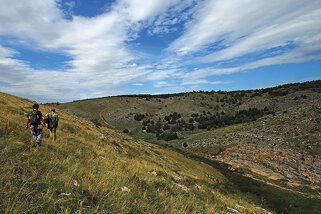
Minervino Murge is part of the Alta Murgia National Park together with twelve other Municipalities and is among the largest in the country with its 68,077 ares. The territory of the Park is characterized by a suggestive succession of rocky crests, sinkholes, gentle hills, swallow holes, karst cavities, steep slopes, blades, extensive natural and cultivated pastures, oak and conifer woods, where the perennial action of nature mixes and coexists with the millenary action of man who has built stone farmhouses, sometimes fortified to defend themselves from the attacks of marauders, equipped with fences and stables for flocks, cisterns, snow houses, small churches, mirrors and infinite networks of dry stone walls. Alta Murgia is therefore the place where the history of man is tangible in the complex mosaic that outlines the stone landscape and tells stories of wandering shepherds, of farmers engaged in the processing of milk and wool and in the cultivation of cereals, almonds and vines. Since September 2024, the Alta Murgia Park has been part of the UNESCO global geopark system. In the territory of Minervino you can immerse yourself in nature trails of rare beauty where you can practice nature trekking through the fascinating Murgia ridge characterized by deep valleys. Along a historical route, along the ancient Lama Matitani, you reach the Grotta di San Michele Arcangelo, located in a large karst cavity, an imposing setting that has been a place of worship for over a millennium. The path of William is a pilgrimage that starts from the Sanctuary of Montevergine, near Mercogliano (AV), and has as its destination the Basilica of the Holy Sepulchre of Barletta. In Minervino, with the Grotta dell’Arcangelo Michele, the Path intertwines with the Michaelic thread. Another path leads from the Copparone sinkhole to the Montelisciacoli quarry, a hiking ring along the ancient sheep tracks of the Alta Murgia, from which a geological path and a naturalistic trail branch off. The crest of the Coste Cirillo offer spectacular views from Lucania to Gargano.
FOOD AND WINE
RITES AND EVENTS
HISTORICAL CENTER
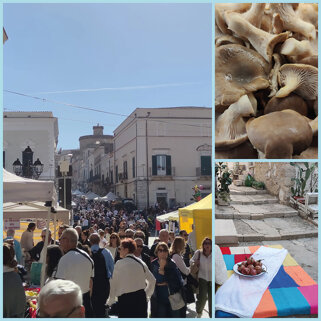
The Easter rites are deeply felt and begin on Good Friday with the procession of the Addolorata. On Holy Monday, the Feast of the Minervino butchers takes place, who accompany the Blessed Sacrament in procession. The Patronal Feast of the Madonna del Sabato is celebrated 15 days after Holy Easter. The traditional event is on May 8th with a pilgrimage for the Feast of San Michele in Grotta, a popular festival in which the sacred and the profane, folklore and worship merge. During the summer months, the Villa Faro and the Historic Center are transformed into an open-air stage, with events ranging from music to art and food and wine, offering unforgettable evenings under the stars. Enjoy the charm of the long summer evenings and the warmth of local hospitality. Among the historical events that deserve special mention, the Notte Bianca (White Night) (August 10th), Nottingrotta (August 16th) and the Grape and Wine Festival (August 20th) stand out. On September 28, 29 and 30, San Michele Arcangelo is celebrated and on the last Sunday of October the Sagra del fungo cardoncello returns, during which the main and renowned gastronomic specialties of the Murgia are proposed, among which, in addition to the delicious mushroom, the tasty turnip tops stand out. The Christmas holidays open with the traditional Bonfire for the Feast of the Immaculate Conception (December 7) and continue with the inauguration of the traditional monumental nativity scene and the various events planned within the Christmas program.
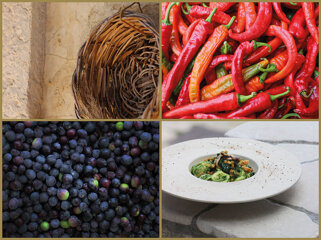
The food and wine tradition reveals an enviable heritage of flavors and lives again, as in a story, in the sublime art of conviviality of local restaurants. To taste the famous turnip tops, the delicious cheeses of the ancient farms, the knife-point pork sausage, the traditional peasant dishes enhanced by the unmistakable EVO oil, completing the taste experience with a tasting of the superlative wines of the local cellars and in the autumn period by the famous cardoncello mushroom, the flagship product of Alta Murgia. The "Cima di rapa di Minervino", (PAT since 2006), has been cultivated for over a century. The peculiar characteristics of this vegetable are attributed to the soil and climate conditions of the area and the cultivation technique adopted. Autumn and spring are the periods of the year in which, in the vast territory of the Murgia, "his majesty" the cardoncello mushroom is collected. This particular cultivation represents an important piece of the popular tradition of the Murge. Not to be missed is the Sagra that takes place every year on the last weekend of October, an event that attracts tens of thousands of visitors every year, curious to taste the local delicacies and immerse themselves in the culture of Alta Murgia.
MAPPEDITALIA SOCIAL
Mappeditalia.it © Tutti i diritti riservati