Mappeditalia.it © Tutti i diritti riservati


HISTORICAL INFORMATION
HOUSE OF THE MIRACLE OF S.FRANCIS
OLD POMARICO
The origins of Pomarico date back to ancient times, as evidenced by the discovery of two ancient settlements: Pomarico Vecchio and Castro Cicurio. The former, dating back to before the 5th century BC, was a fortified Lucanian settlement located a dozen kilometers from the current town, influenced (4th century BC) by Greek colonies that transformed the area along the lines of Greek cities. The latter, dating back to Roman times, arose on the site of an earlier Greek settlement, Cichurus. The current town dates back to the 9th century AD, after Pomarico Vecchio was repeatedly raided by the Saracens, who were interested in the area due to its strategic position. Under the Normans, Pomarico's history became linked to that of the County of Montescaglioso and thus also to the dispute, concluded in 1714, between the rulers of the latter and those of the Benedictine Abbey of San Michele Arcangelo. The abbey was assigned the portion of land where Castro Cicurio was located. Numerous feudal lords succeeded one another in ruling the Matera town, starting with Francesco II del Balzo, followed by the Lords of Avalos, the Orsini family, the Naselli family, and the Miroballo family. In the second half of the 18th century, the Donnaperna family built the Palazzo Marchesale. The town's name may derive from the Latin Pomi Ager (fruit field, land rich in trees). The Franciscan Sources remember Pomarico for the famous "miracle" of Saint Francis. In a house located in the historic center of Pomarico, a symbol carved into a set stone commemorates the miraculous event. Pomarico is the birthplace of Niccolò Fiorentino, patriot and scholar; Camillo Giuseppe Giordano, botanist; Don Pietrangelo Spera, historian and man of letters; and Camilla Calicchio, mother of the Venetian musician Antonio Vivaldi.
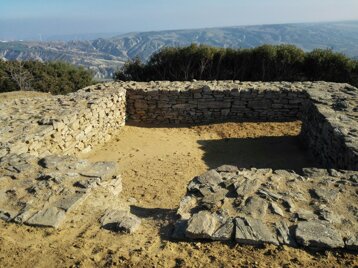
A settlement, sometimes mistakenly referred to as Castro Cicurio, located 12 km from Pomarico. Situated at 400 m above sea level, it occupies the flat summit of a hill, also known as San Giacomo, to the left of the Basento River and 23 km from the Greek polis of Metaponto. The indigenous settlement, dating back to at least the second half of the 6th century BC, saw its greatest development between the 4th and 3rd centuries BC. The settlement area consists of a pear-shaped space approximately 330 m in a north-south direction and approximately 200 m in an east-west direction, surrounded by a wall built in the second half of the 4th century BC. The double-faced wall is made of local sandstone slabs with an amplekton, in which sections of curtain wall (now partially collapsed) alternate with imposing quadrangular towers. This isolated hill, which affords a complete view of the surrounding valleys, offered ideal conditions for a settlement in ancient times, allowing easy control of inland access routes. Systematic excavations, begun in 1976, initially focused on the walls and a necropolis located on the southwest slope, before focusing on the settlement itself. Evidence of human presence as early as the second half of the 6th century BC comes from the discovery of pottery typical of that period, particularly fragments of Ionic cups of the B2 type and several fragments of banded decoration. In the second half of the 4th century, the southern portion of the settlement (the only one excavated to date) was completely restructured, or perhaps restructured, following the typical pattern of Greek cities, based on a regular succession of parallel streets, abutting other orthogonal ones, creating narrow, elongated blocks. At the end of the 1993 excavation campaign, it was possible to identify four blocks and the probable presence of two others, divided by parallel streets (stenopòi). Turning to the finds, the most significant number of artefacts dating back to the 4th-3rd century BC consists of ceramics. The significant number of loom weights found also testifies to the diffusion of weaving. Insights into the forms of religiosity of the inhabitants are offered by some coroplastic fragments, similar to those of the nearby Greek poleis, which testify to cults connected to the chthonic world, reflected in recumbent figures, sileni and large female busts. Significant data are offered by the excavations on the eastern slopes of the Pomarico Vecchio hill, which have brought to light fifteen earthen pit tombs, covered with sandstone slabs. The grave goods, which feature predominantly Greek-type materials, nevertheless show a persistence of Italic typologies, with the crouched position of the gravestones.
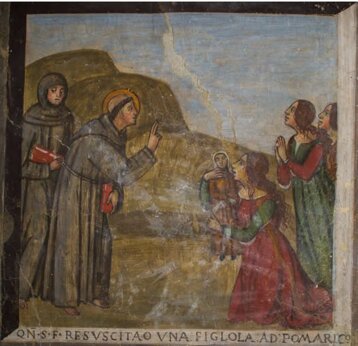
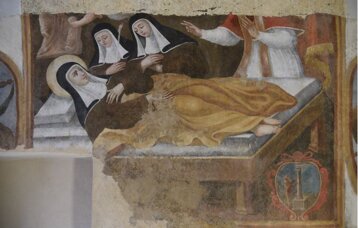
Among the narrow streets of Pomarico's charming historic center, you can walk along the Via della Luce di San Francesco (Way of Light), which leads to the Casa del Miracolo (House of the Miracle). Here, as one of the Saint's biographers, Tommaso da Celano (1200-1270), wrote in his TRACTATUS DE MIRACULIS (Tractate of Miracles) of 1252-1253, one of the three miracles in Basilicata occurred through the intercession of the Saint of Assisi, a few decades after his death on October 3, 1226. It is said that a mother from Pomarico was reunited with her only daughter, who had died at a young age, thanks to the intercession of Saint Francis. The House, which remained intact for centuries, features a calcarenite cube with the Franciscan symbol on one façade. Inside, there are two fireplaces and an arch in which a small statue of the Saint now stands. Every year on October 4th, the day dedicated to Saint Francis of Assisi, the patron saint of Italy, the miracle is commemorated by lighting a lamp in the house and displaying the relic of Saint Francis preserved in the Church of Saint Anthony. The initiative is promoted by the Pro Loco of Pomarico "E. Mattei" in collaboration with the Parish of Saint Michael the Archangel and the Municipal Administration.
ANTONIO VIVALDI AND POMARICO
The famous composer and violinist Antonio Vivaldi had a touch of Pomarico blood flowing through his veins. The historical identity of Pomarico dates back to 1649, when Camillo Calicchio, the musician's grandfather, emigrated from Pomarico at a young age to seek better fortune in Venice. There he married Zanetta Temporini, who bore him Camilla Calicchio, the musician's mother. In keeping with Pomarico tradition, the young craftsman (Camillo Calicchio, Antonio Vivaldi's grandfather) cultivated, in addition to his trade as a tailor, a passion for music, which was considered, at the time, a craft. Thanks to the discovery of documents on the musician's Pomarico origins in the Patriarchal Archives of Venice by historian Don Vio Gastone, they were published in 1983 in the Vivaldi magazine, edited by the IS. A. Vivaldi, Fondazione Cini, Venice: A series of documents with certificates of provenance on the Pomarico origins of Antonio Vivaldi, considered one of the greatest exponents of Baroque music and one of the greatest virtuosos of his time. A priest, although unable to celebrate Mass for health reasons, he was known as "the Red Priest" for the color of his hair. Vivaldi contributed significantly to the development of the concerto, especially solo (a genre initiated by Giuseppe Torelli), and to violin technique and orchestration. He also cultivated opera, and his vast catalog includes numerous concertos, sonatas, and sacred music compositions.
TOURIST ROUTE - FIRST PART
TOURIST ROUTE - SECOND PART
TOURIST ROUTE - THIRD PART
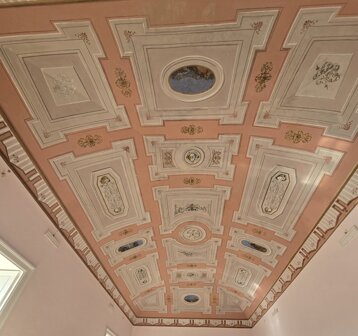
A tourist itinerary through the town of Pomarico can certainly be described as an evocative journey through the history, culture, and flavors of one of the most charming villages in the province of Matera. In the historic center, the 18th-century Palazzo Marchesale, or Donnaperna, stands out for its grandeur and artistic value. From an urban planning perspective, the building stands alone on the edge of the historic center, serving as a link between the old town and the newly expanding neighborhoods. It consists of three floors above ground plus a roof, a remarkably imposing structure. Of all the buildings, its imposing mass and architectural magnificence make it the only one comparable to the Mother Church. The Palazzo was built in 1773 by the Neapolitan engineer Giuseppe Fulchignano, commissioned by Baron Don Giulio Cesare Donnaperna, eldest son of Baron Giuseppe Paolo Donnaperna of Tursi. The Donnaperna family, in fact, purchased the fiefdom of Pomarico from the Prince of Castellaneta and Lord of Pomarico, Don Nicola Miroballo, due to the latter's unforeseen financial difficulties. The Donnaperna family acquired the fiefdom in 1771 after years of negotiations and after the Grand Court of the Vicarage proceeded with the appraisal (estimation) of the fiefdom, ending the long, enlightened, and benevolent Miroballo lordship over Pomarico. The new buyer, however, did not have time to take possession of the fiefdom, as he died the same year of the purchase, having named his eldest son, Don Giulio Cesare Donnaperna, as his heir. It was therefore the latter, in all likelihood, as evidenced by an examination of the dates, who commissioned Fulchignano to build the Palazzo. In the early 19th century, the Palazzo was sold to the Massarotti family, who subsequently sold it, divided into several parts, to various owners, including the Municipality, which holds almost all of the rooms. After the renovation and architectural restoration of the Palazzo, individual sections were restored to their original aesthetic splendor and given new cultural functions. This was the case with the Museum of Peasant Culture and Popular Traditions, located on the first floor, which houses many obsolete farming tools. The Ballroom, of particular beauty and charm, was also restored, now hosting conferences or providing a worthy venue for chamber concerts. An equally precious jewel, although its restoration has not yet been completed, is the octagonal Hall of Mirrors. Another completely restored space is the Courtyard—a large open space at the center of the Palazzo—with its characteristic cobblestone pavement restored to its original state, and the Donnaperna family crest embedded in its center. The Casa della Cultura, a hub for a wide variety of cultural initiatives and activities, is located on the ground floor and is managed by the Pro-Loco.
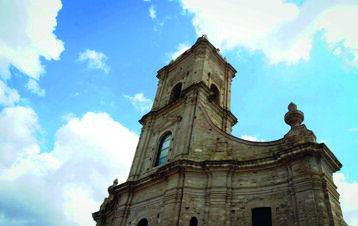
In the Castello district, the old Pomarico, we can admire the Old Church and the Church of the Madonna del Monte, along with several stately buildings adorned with characteristic stone portals and wrought-iron railings. A treasure trove of sacred art is the majestic Mother Church, dedicated to Saint Michael the Archangel. Construction began in 1748 and was completed in 1783, as evidenced by the inscription on the stucco decoration above the central nave. On the late Baroque façade, we can observe the division into two tiers, an upper and a lower one, separated by a cornice. The lower section is characterized by a succession of concave and convex surfaces, while the upper section is characterized by the thirty-six-meter-high bell tower grafted onto the central body, which was built in 1792. The façade is given dynamism and movement by the interplay of concave and convex shapes and by the presence of six adjoining pilasters that punctuate the imposing central portal and the two side entrances. The large amphitheater-like churchyard, which seems to welcome the faithful in a symbolic embrace, was built in 1803 to contain rainwater. The church has a Latin cross basilica plan, with the nave divided into three longitudinal naves and intersected perpendicularly by the large transept. At the center of the transept is a dome with pendentives, decorated in the center by a dove, symbolizing the Holy Spirit, and by figures of cherubs, which emerged after the recent restoration. The imposing semicircular central apse is flanked by two lateral apses, one housing the Chapel of the Blessed Sacrament and the other the Chapel of St. Michael the Archangel, patron saint of Pomarico. Inside are paintings by Pietro Antonio Ferro dating back to 1601 and Andrea Vaccaro, a wooden statue of St. Michael dating back to 1400, and a valuable 16th-century antiphonary. The Church of the SS. Addolorata is the oldest in the town. It was built in the 9th century AD following the relocation of the inhabitants of Pomarico Vecchio and was originally dedicated to St. Margaret, or Marina, as she was known in Eastern Europe. Her cult, along with that of St. Nicholas, was widespread throughout southern Italy due to the long Greek-Byzantine domination. With the arrival of the Normans, however, Pomarico was assigned as a fief to the County of Montescaglioso, and the cult of St. Margaret was replaced by that of St. Angelo or St. Michael the Archangel. The current structure is the result of modifications and expansions over the centuries. Some remains of the original walls testify that the church was originally a small chapel, sized for the small number of inhabitants. It was only dedicated to the Blessed Virgin of Sorrows, or Mater Dolorosa, in 1741. The interior of the church, in addition to the important stucco altar by Antonio Selvaggi, is embellished with several paintings by the Lucanian artist Pietro Antonio Ferro. In 2010, a restoration of the altars brought back their original colors, which had yellowed with time.
This meticulous work of paint removal and stucco work highlighted the artistic and architectural significance of this ancient church. The Civic Clock Tower has marked the time of the Pomarico community for centuries. It was originally located on the façade of the Old Mother Church. In 1615, after the church's collapse, it was placed on one of the four shops in Piazza Santa Margherita. For centuries, it was the only time reference that farmers had to mark the working day in the countryside. It is kept alive with periodic maintenance by the Pomarico Proloco. The Convent of Sant'Antonio da Padova is located along the main artery of the Municipality of Pomarico and is closely connected to the adjacent Church of Sant'Antonio da Padova, with which it shares a load-bearing masonry wall oriented NW-SE. The building is currently used as the Town Hall, but recent restorations, although they have changed its intended use, have nevertheless preserved its main architectural features. The entire convent is structured around two quadrangular cloisters, separated by a wall span serving as a distribution structure. The stairs to the upper floor are located at the point where the two cloisters meet. The two cloisters are bordered by a long cross-vaulted corridor that leads to the church of Sant'Antonio and other areas used for kitchens and common rooms. The original 17th-century frescoes that once adorned the building are still visible in some rooms. The frescoes depict scenes from the life of Saint Clare, the Life of the Virgin, and the Martyrs. Construction of the convent continued throughout the 17th century, and between 1670 and 1673, the dormitory wing was built, to which the library was added in 1700. The birth of the Reformed Franciscan convent of Pomarico is clearly a fascinating story, yet to be told. Founded in 1603, the convent complex was later enlarged and embellished with a pictorial cycle in the lunettes of one of the two cloisters and the founding of a notable library. A very recent extraordinary discovery, in what was once the main entrance, is of a cycle of original frescoes, in good condition, saved from decay by a light layer of lime. The Church of Sant'Antonio was built in 1603. It is part of the same convent, a large architectural complex located in the Contrada formerly known as Piana or San Sebastiano. Recent restoration removed the three original altars to the right of the entrance, revealing a smaller side nave leading to the sacristy. The central nave culminates in the presbytery with a stone altar decorated and painted with marble inlay. The apse houses a carved and inlaid wooden choir, the work of Antonio la Raja da Laurenzana, from the 18th century, and a series of valuable paintings. The altar features two stone frontals decorated with volutes of plant motifs, while the center, against a dark background, features floral and animal motifs. The Piana, or Castello district, was the first part of the town to be inhabited by the Pomarico people (mid-9th century). The name derives from an ancient fortress built by one of the first lords of Pomarico, of which only a few ruins remain.
MANFERRARA WOODS
GASTRONOMY
RITES AND EVENTS
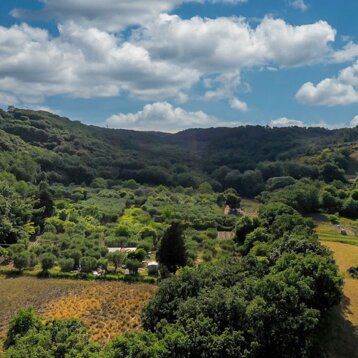
The picturesque Manferrara Forest extends over 500 hectares on the edge of the urban area. The area, characterized by a hilly landscape and wide paths, offers tourists the opportunity to enjoy wellness treatments and also features a picnic area. Various species of plants and trees can be admired, from maple, flowering ash, Aleppo pine, and dog rose to undergrowth plants such as myrtle, mastic, butcher's broom, and hawthorn. The predominant tree species are oaks, particularly Turkey oak, downy oak, and holm oak. The area is rich in wildlife: foxes, wild boars, martens, badgers, and various bird species, including the great woodpecker. For hiking enthusiasts, the forest offers a modern, characteristic and well-structured trail, which complements a more rugged, rarely used, dirt trail.
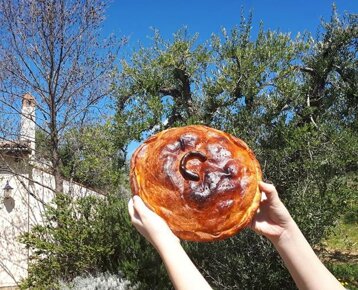
Pomarico's age-old culinary tradition exalts the flavors of products considered "poor," yet they offer unmistakable tastes, thanks to the use of natural and simple ingredients, expertly balanced. The produce of the land preserves the flavors and aromas of times gone by. The full-bodied, bold extra virgin olive oil enhances traditional dishes made with fresh, homemade pasta and special taralli, crispy and flavorful, called "scaldatelle" because they are heated in boiling water before being baked. The meat cooked in wood-fired ovens is particularly delicious. A product of excellence is undoubtedly the scarcella, a rustic Pomarico specialty. It is a savory Easter pizza like many others found in our regional traditions, consisting of two discs of fennel-flavored dough filled with sausage, scuallëtë (scallato) cheese, and hard-boiled eggs. The top crust, thinner than the bottom, is often decorated and brushed with egg yolk before baking. Once ready, the pie turns golden brown, with a fragrant flavor and aroma. This rich, savory stuffed pizza was meant to be eaten on Easter Monday, or Easter Monday. Traditionally, preparation of the Scarcella began on the evening of Holy Thursday and involved all the women in the house. As the days lengthened and temperatures cooled, the laying hens began to produce abundant eggs after their winter break, and at the same time, the ewes had finished nursing their lambs, so the milk could be used to produce the necessary cheeses, in this case a fresh cheese called "scallato," typical of Pomarico. Although hard to find, it could be replaced with a good fresh pecorino, primosale, or tuma. Since 2022, it has been recognized as PAT (Italian Agri-food Products), a brand created by the Ministry of Agricultural, Food and Forestry Policies to protect a series of niche products.
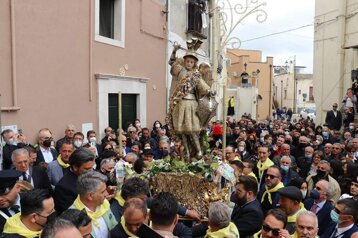
From May 7th to 9th, Pomarico celebrates its patron saint, Saint Michael the Archangel. This tradition has preserved the allure of an ancient and solemn celebration, through which the entire community participates in an event that is both religious and civic. Everyone, even those who have had to leave their homeland, recalls the sentiments, memories, and traditions that accompany them throughout their lives, encouraging them to honor their origins and rediscover their sense of belonging to the community. The "Offerta della Cera" (Offer of Wax), made by the Mayor on May 7th, to thank the patron saint for saving Pomarico from the bubonic plague and then from famine, is one of the most heartfelt moments of the festival. This offering honors and respects a commitment made by the civil authorities of the time, sanctioned by a notarial deed that has been honored for centuries. On May 8th, in addition to the morning procession, great emphasis is placed on the "Miracle of the Wheat," known as the "FIGHT," through a historical reenactment organized by the Pro Loco. On May 9th, the festival concludes with an evening of music. The Pomarico miracle of the wheat is a legend linked to the famine of 1757, which saved the community from starvation thanks to Saint Michael the Archangel. Legend has it that a merchant, hired by a man named Michael, arrived in Pomarico with eight carts loaded with wheat. After the starving population seized most of the wheat, the merchant went to the church to pay, but discovered that the mysterious man was none other than Saint Michael, who was missing the ring he had pledged. The "Festa del Miracolo di San Francesco" in Pomarico is celebrated on October 4th. The festival is dedicated to the memory of a miracle linked to Saint Francis and takes place primarily at the Church of Sant'Antonio. The celebration is organized by the Pro Loco of Pomarico.
MAPPEDITALIA SOCIAL
Mappeditalia.it © Tutti i diritti riservati